
Silver Mercury for Gold Mining, the trade name for elemental mercury (Hg), is the dense silver-colored liquid metal that has been used for centuries to bind fine gold particles into an amalgam. If you are sourcing it, you are dealing with a regulated hazardous material where purity claims, documentation, and destination-country legality carry as much weight as price. The two questions that decide whether a mercury purchase is viable are simple: can the supplier prove the grade with a third-party certificate of analysis, and can you legally import and use it where you operate?
Cavin Resource supplies high-purity silver mercury (quicksilver) at 99.99% purity in sealed steel flasks, including 34.5 kg formats, with COA and MSDS provided on every order and shipments moved through certified hazardous-materials carriers. If you need grade specifications, packaging details, or export documentation for a qualified application, you can reach the team through the WhatsApp live chat on the website to discuss quantities, destinations, and permit requirements.
This guide covers what liquid silver mercury actually is, how grades differ, where amalgamation fits into gold recovery, and what to demand from a mercury supplier before you commit funds.
Key Takeaways
- Purity claims for pure liquid mercury mean nothing without a third-party COA and matching batch documentation.
- Mercury-gold amalgamation is legally restricted in many jurisdictions under the Minamata Convention, and import permits are the buyer’s responsibility.
- Serious suppliers ship in UN-approved steel flasks with COA, SDS, and full export paperwork attached to each consignment.
What Silver Mercury for Gold Mining Is and Why Grade Matters
Silver mercury is not silver at all. It is elemental mercury, CAS 7439-97-6, a liquid metal at room temperature with a mirror-like surface and a specific gravity of roughly 13.5, and the difference between a 4N and a 5N grade shows up directly in contamination risk and equipment behavior.
Names, Identity, and Core Chemical Properties
You will see the same material sold under a half-dozen names: metallic mercury, quicksilver, hydrargyrum, liquid silver, virgin silver liquid mercury, or simply Hg. All refer to the same element.
| Property | Specification |
|---|---|
| Chemical formula | Hg |
| CAS number | 7439-97-6 |
| Molecular weight | 200.59 |
| Appearance | Silver liquid, mirror luster |
| Odor | Odorless |
| Melting point | -38.87 °C |
| Boiling point | 356.72 °C |
| Specific gravity | 13.53 to 13.59 (water = 1) |
“Virgin” mercury means the material has never been used or reclaimed. Recycled mercury can carry trace metals from prior service, which is why the distinction appears on nearly every quality spec sheet.
Comparing 99.99% and 99.999% Mercury Grades
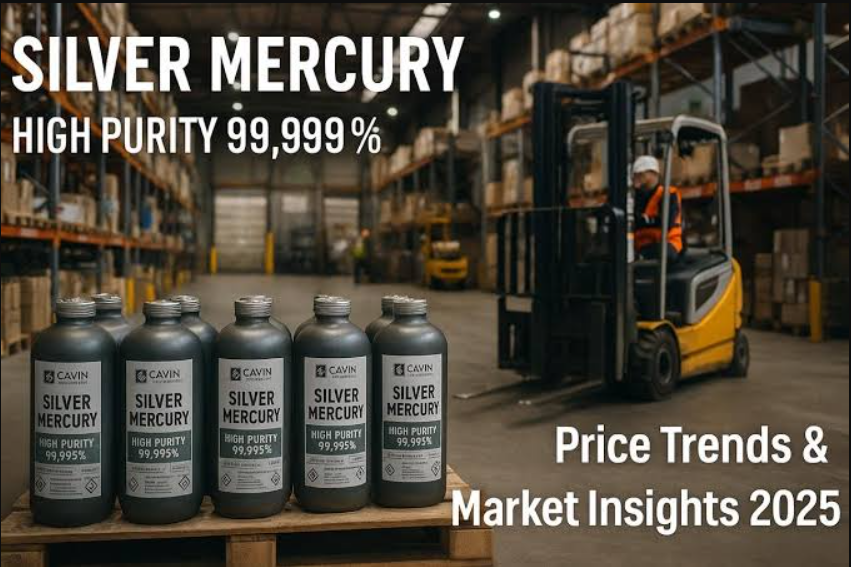
99.99% (4N) is the standard commercial grade for industrial amalgamation, gold processing, and most general laboratory work. It is the grade Cavin Resource supplies, and it satisfies the vast majority of qualified applications.
99.999% (5N) is an analytical-pure grade requested for calibration standards, high-precision instrumentation, and sensitive chemical synthesis. Some sellers reference legacy standards such as GB 913-85 when describing these tiers.
The practical difference is trace heavy-metal content. Lower-grade or recycled mercury may carry lead, zinc, or cadmium residues that accelerate corrosion in contact equipment and skew analytical results. Suppliers of 99.999% pure virgin silver liquid mercury consistently emphasize being free from heavy metals for exactly this reason.
How to Evaluate Purity Claims and Test Results
Treat purity as unproven until the paperwork supports it. A credible mercury purity test package includes an independent lab COA naming the analytical method, the batch or lot number, and the impurity table with detection limits.
Three checks worth running every time:
- Match the batch number on the COA against the flask seal and packing list.
- Look for an impurity breakdown, not just a headline percentage. A COA that says “99.999%” with no element-by-element data is marketing, not analysis.
- Question unusually cheap 5N quotes. As guidance on silver mercury price and compliance notes, extraordinary purity claims at low prices should be treated as unverified until documentation and seller identity are confirmed.
Gold Processing Context and Responsible Boundaries
Mercury-gold amalgamation remains one of the oldest gold recovery methods in use, but its role is narrowing under international law and improving alternative technology. Where it still appears, ore characteristics, particle size, and legal status determine whether it is appropriate at all.
Where Mercury-Gold Amalgamation Appears in Gold Recovery
The mercury gold extraction process is mechanically simple. Liquid mercury is introduced to gold-bearing ore or concentrate, it wets and binds free gold into a mercury-gold amalgam, the amalgam is separated from the gangue, and heat drives off the mercury to leave the gold behind.
The EPA describes how elemental mercury is mixed with gold-containing materials to form an amalgam that is then heated to vaporize the mercury. That vaporization step is the point of greatest exposure risk, and it is why retorts and condensers exist.
Why Fine Gold and Ore Characteristics Affect Process Decisions
Amalgamation was historically favored for very fine gold in river sand and alluvial concentrate, where gravity methods alone leave recoverable metal on the table. Coarse gold is usually captured well by sluices, shaking tables, and centrifugal concentrators without any chemical assistance.
In practice, operators who upgrade their gravity circuit first frequently discover that their mercury consumption drops sharply. Field trials by the Alliance for Responsible Mining and Mercury Free Mining have demonstrated mercury-free processing systems achieving competitive recovery on artisanal ore.
Health, Environmental, and Legal Limits on Use
Artisanal and small-scale gold mining is the single largest global consumer of mercury. UNEP estimates ASGM accounts for 37% of total mercury releases, roughly 2,200 tonnes annually, with virtually all mercury used ending up in the environment.
Mercury vapor is neurotoxic and odorless. Open-air amalgam burning without a retort exposes the operator and everyone nearby.
The Minamata Convention obligates parties to reduce and where feasible eliminate mercury in ASGM, and many countries now restrict or prohibit its import for this purpose. Buyer eligibility is jurisdiction-specific and non-negotiable.
Specifications, Packaging, and Documentation to Request
A complete procurement package for liquid mercury covers grade, batch traceability, containment format, and the safety and analytical paperwork that customs and your own EHS team will ask for. Missing any one of these stalls the shipment.
Essential Specification Fields for Procurement
Before you accept a quote, confirm these silver mercury specifications in writing:
- Purity by weight (99.99% minimum, or 99.999% if the application requires it)
- Virgin vs. reclaimed origin
- CAS 7439-97-6 and chemical formula Hg
- Impurity limits for lead, cadmium, zinc, copper, and other trace metals
- Batch or lot number tied to the analysis
- Net weight per unit and total consignment weight
- Country of origin and manufacturer identity
- HS code for the destination customs entry
Ambiguity in any field is worth resolving before payment, not after the container is at port.
Flasks, Custom Packaging, and Transport-Ready Containment
The industry standard unit is the 34.5 kg (76 lb) sealed steel flask, often described as an iron cylinder or iron flask, secured inside a reinforced wooden crate for transit. Cavin Resource supplies mercury in sealed steel flasks including the 34.5 kg format, with customized packaging available on request.
What to inspect on arrival: intact factory seals, no visible corrosion or weeping at the closure, correct UN hazard labeling, and crate integrity. A flask that has shifted inside a poorly braced crate is a leak waiting to happen.
Using COAs and SDSs for Purchase Approval
The certificate of analysis proves grade. The safety data sheet governs handling, storage, PPE, spill response, and transport classification. Both should arrive before the goods, not with them.
Route the SDS to whoever manages hazardous materials at your site so exposure controls and storage arrangements are in place ahead of delivery. Suppliers offering high purity silver mercury with COA, SDS, and export documentation as standard practice make this straightforward.
Legitimate Industrial and Scientific Applications
Mercury supply is not limited to mining. A meaningful share of demand comes from calibration, instrumentation, and specialized manufacturing where no substitute performs equivalently, and responsible suppliers screen intended use before confirming an order.
Laboratory, Research, and Calibration Requirements
Analytical laboratories use elemental mercury in porosimetry, in reference standards for mercury analysis, and in scientific instruments including manometers and barometers. Calibration and measurement work typically demands the tighter 5N grade, since trace contaminants shift the density and vapor pressure values the instrument depends on.
Scientific research applications, including chemical synthesis and electrochemistry, generally involve small volumes but strict traceability. Batch-level documentation matters more than order size here.
Specialized Technical Manufacturing Uses
Electroplating operations, mercury rectifier equipment, and mercury vacuum pumps still exist in service in certain industrial settings, and replacement or top-up mercury must match the original specification. The lighting industry has historically used mercury in fluorescent and high-intensity discharge lamp manufacturing, though volumes there continue to decline.
Limited dental amalgam applications remain in some markets, subject to national phase-down commitments.
Application Review Before Supply
Expect a legitimate mercury exporter to ask questions. Stated end use, company registration, destination country, and permit status all inform whether a shipment can proceed.
That review protects both parties. A supplier who does not ask about intended use is either inexperienced or indifferent to the compliance exposure, and neither is a good sign for a hazardous-materials transaction.
Compliance, Safe Handling, and International Export Review
Elemental mercury moves under overlapping national and international controls, and the practical burden of clearing it falls on the importer as much as the exporter. Packaging standards, carrier certification, and site storage all have to line up before a shipment leaves origin.
Permits, Import Controls, and Destination-Country Checks
Start with the destination. Many jurisdictions require an import permit, an environmental authority notification, or prior informed consent under the Minamata framework before mercury can enter.
The United States is a useful example of how restrictive the picture can be. The Mercury Export Ban Act of 2008 prohibits export of elemental mercury from the US specifically to limit its global commercial availability, and separate provisions address domestic storage.
Verify your own eligibility before requesting a quote. It saves weeks.
Hazardous-Materials Packaging and Carrier Requirements
Mercury ships as UN 2809, Class 8 dangerous goods. Containment must be leak-proof, corrosion-resistant, and UN-approved, with correct marking, labeling, and a dangerous goods declaration accompanying the consignment.
Not every freight forwarder handles Class 8 liquids. Confirm your carrier is certified for hazardous materials on the specific route and mode, and that the booking reflects the correct UN number and packing group from the outset.
Storage, Exposure Control, and Incident Preparedness
Store flasks upright, sealed, in a cool and well-ventilated area on a non-porous, sealed floor with secondary containment beneath. Avoid warm areas; vapor pressure rises with temperature.
Protective gear for any handling includes nitrile gloves, chemical splash goggles, and a lab coat or coveralls, with respiratory protection where vapor exposure is credible. Keep a dedicated mercury spill kit with sulfur powder or a commercial amalgamating absorbent on hand, never a household vacuum, and know your reporting obligations before an incident rather than during one.
Working With Cavin Resource on Qualified Orders
Cavin Resource supplies high-purity silver mercury as part of a broader industrial chemicals portfolio serving buyers across Africa, Asia, the Middle East, and Europe. Orders are handled with the documentation, packaging, and carrier arrangements that hazardous-materials shipments require.
Available Grades and Procurement Support
The standard offering is 99.99% purity elemental mercury, supplied in sealed steel flasks including the 34.5 kg format, with customized packaging available where an application or route calls for it. Buyers evaluating whether certified 99.99% silver mercury fits their specification can request full property data and impurity limits before committing.
Procurement support covers minimum order quantities, packaging configuration, and lead-time planning for repeat requirements.
Documentation and Export Coordination
Every order ships with a certificate of analysis and a material safety data sheet. Packaging is leak-proof, corrosion-resistant, and UN-approved for hazardous materials, and international consignments move through certified hazardous-materials carriers with compliance documentation attached.
Importers remain responsible for securing local permits and any destination-country authorizations. The export side of the paperwork is coordinated from Malaysia to align with what your customs authority expects.
Information to Provide When Requesting a Quote
Have this ready and the quote turnaround shortens considerably:
- Quantity in kilograms or number of flasks
- Required purity (99.99% or higher, if your application demands it)
- Destination country, port, and Incoterms
- Stated end use and industry sector
- Permit or licence status for import into your jurisdiction
- Company registration details and contact for hazardous-materials clearance
- Packaging preference, standard flask or customized
Quotes, minimum order quantities, and documentation requests are handled through the WhatsApp live chat on the Cavin Resource website.
Frequently Asked Questions
Is mercury still used in gold mining today?
Yes, primarily in artisanal and small-scale gold mining, which UNEP identifies as the sector consuming the largest quantity of mercury worldwide. Its use is being phased down under the Minamata Convention, and many countries now restrict or prohibit mercury imports for gold recovery. Large industrial mines generally use cyanidation and gravity circuits instead.
How does mercury separate gold from ore?
Liquid mercury wets and dissolves free gold particles on contact, forming a mercury-gold amalgam that is denser than the surrounding sand and rock and therefore easy to separate. The amalgam is then heated so the mercury vaporizes and leaves the gold behind. Doing that heating in the open air releases toxic mercury vapor, which is why retorts and condensers are essential.
How long does it take for mercury to dissolve gold?
Fine, clean gold particles begin amalgamating almost immediately on contact, with visible wetting within seconds to minutes. Coarser or surface-coated gold takes longer and may require agitation over several hours to reach full contact. Ore chemistry, particle size, and any oils or clays present all slow the reaction.
What is the current price of mercury per kilogram?
Elemental mercury pricing moves with grade, order volume, origin, and freight, so there is no single published spot figure comparable to exchange-traded metals. Quotes are typically issued per 34.5 kg flask or per metric ton against a specific destination and Incoterm. Treat any quote far below prevailing market levels as a reason to verify the COA and seller identity before proceeding.
Where can mercury be legally purchased for industrial or laboratory use?
From licensed chemical suppliers and exporters who verify end use, provide a certificate of analysis and safety data sheet, and ship in UN-approved hazardous-materials packaging through certified carriers. Legality depends on your destination country’s import controls and any permit requirements under national law. Confirm your own eligibility before ordering, since the importer carries responsibility for local authorizations.
What are the health, environmental, and legal risks of using mercury in gold recovery?
Mercury vapor is neurotoxic and can cause permanent kidney and central nervous system damage, with risk concentrated during amalgam burning. Released mercury converts to methylmercury in waterways and accumulates in fish and the people who eat them. Legally, unauthorized import or use for gold processing can trigger seizure, fines, and prosecution in jurisdictions implementing the Minamata Convention.
 English
 Français
 Afrikaans
 简体中文
简体中文 Čeština
 Suomi
Suomi Deutsch
 हिन्दी
 עִבְרִית
 Norsk bokmål
 Tiếng Việt
 Türkçe
 العربية
 Svenska
 Kiswahili
 Irish
Irish Latin
Latin Polski
 Português do Brasil
 Español de Colombia
 தமிழ்
தமிழ் العربية المغربية
 Dansk
Dansk 日本語
日本語 Hrvatski
 Nederlands
 Eesti
Eesti Luxembourgish
 Bahasa Melayu
 Português
 Ελληνικά
 ဗမာစာ
ဗမာစာ 한국어
한국어 Cymraeg
 Українська
 Slovenščina
 Հայերեն
 Magyar
 Русский
 Tajik
Tajik فارسی
فارسی O‘zbekcha
 Sundanese
 Bashkir
 বাংলা
বাংলা Bahasa Indonesia
 Беларуская мова
 Azərbaycan dili
 Aragonés
 Bosanski
 Dari
Dari ქართული
 Latviešu valoda
 Lingala
 Frysk
Frysk Română
 Gàidhlig
 Turkmen
 Español de Puerto Rico
 ไทย
ไทย 繁體中文
繁體中文 Slovenčina
 Српски језик
 Македонски јазик
 नेपाली
 Монгол
 Maltese
 سنڌي
سنڌي ພາສາລາວ
 Кыргызча
 Қазақ тілі
 Íslenska
 ភាសាខ្មែរ
 Български
 Bhojpuri
 Català
 (فارسی (افغانستان
0 Comments